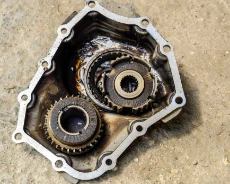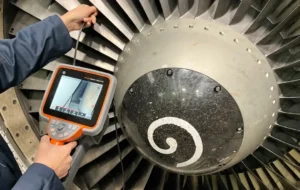

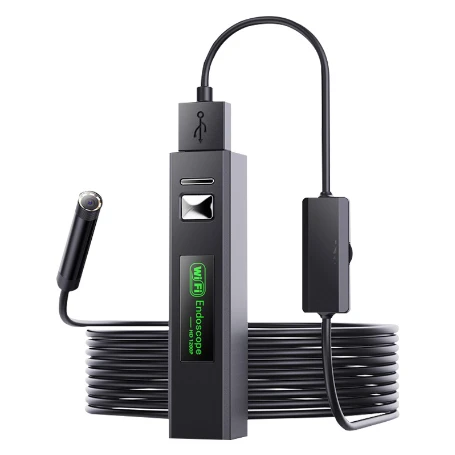
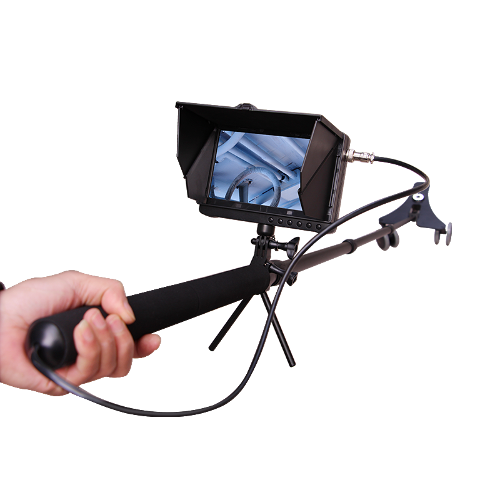
In industrial non-destructive inspection, light sources are not merely used for basic illumination, but provide core auxiliary capability for flaw identification. White light serves as the mainstream light source for ordinary borescopes, while infrared and ultraviolet belong to special invisible light bands. Relying on unique wavelength and optical characteristics, they can complete special inspection work that conventional white-light equipment cannot achieve. This article focuses on a detailed introduction to industrial UV borescopes.
Definition of UV Borescope
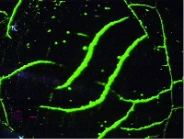
The UV borescope is a special non-destructive testing instrument dedicated to ultraviolet fluorescence inspection. Industrial UV borescopes adopt a customized 365nm ultraviolet wavelength light source, which excites fluorescent agents attached to the surface of workpieces to produce high-contrast luminous signals. This effect clearly displays micro cracks, leakage traces and tiny surface defects that are completely invisible under natural white light.
It has become irreplaceable inspection equipment in high-standard key industries including aerospace and power energy, where structural safety must be fully guaranteed. Note that ultraviolet radiation will cause damage to human eyes and skin; supporting UV-proof protective goggles and gloves must be worn during all inspection operations to ensure safe and stable flaw diagnosis.
Core Components of UV Borescope
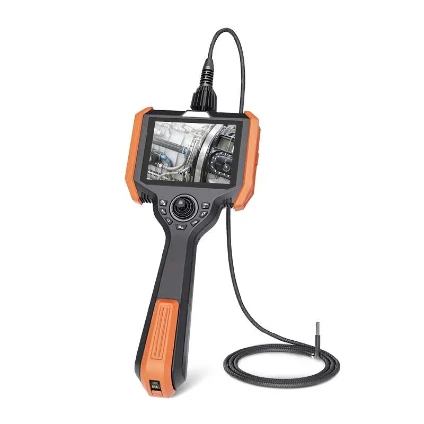
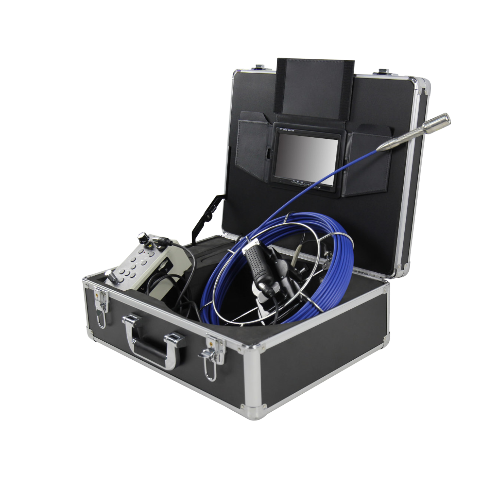
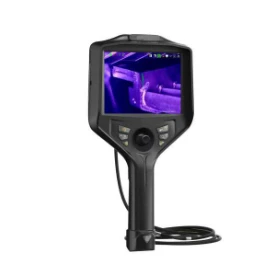
A complete UV borescope is composed of two major core modules: the probe pipeline assembly and the main control host system.
- Articulating Probe Assembly
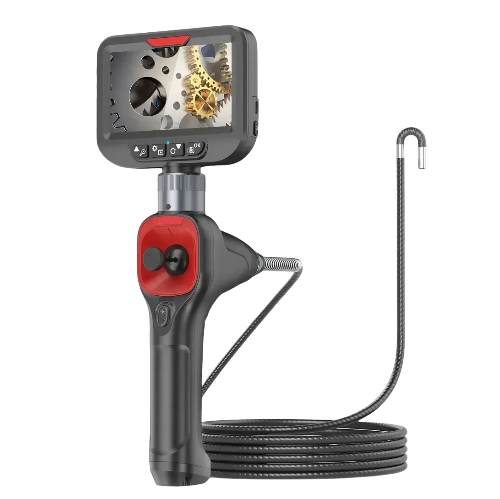
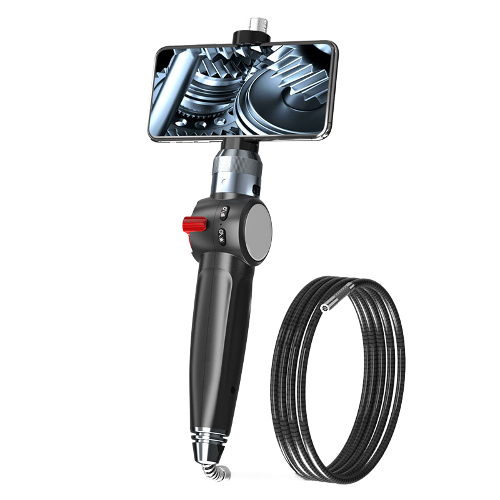
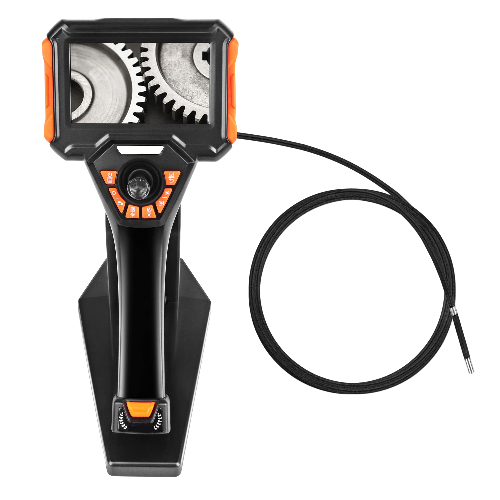
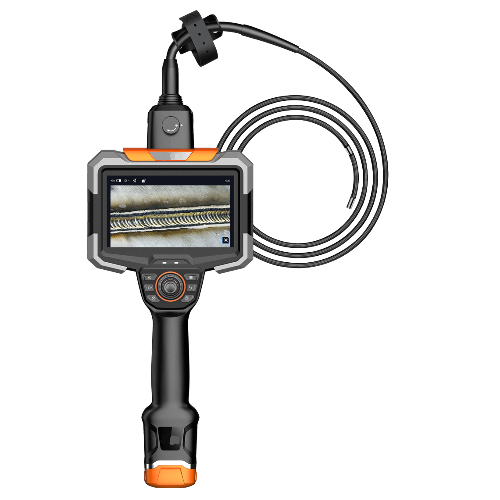
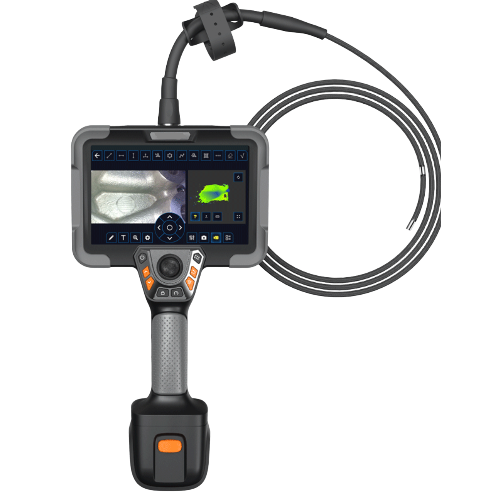
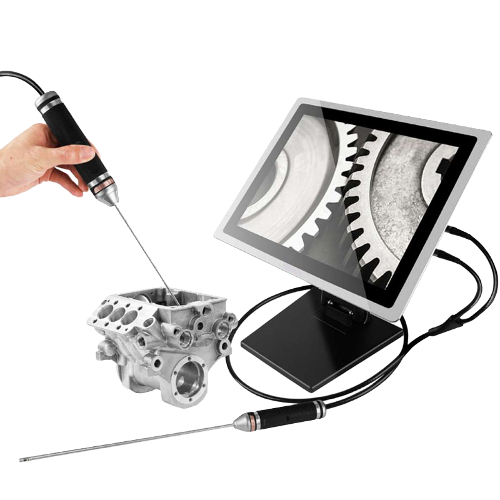
The probe supports full 360° all-direction steering and integrates high-brightness UV LED light source. Multiple models adopt dual-light integrated design with one-key mode switching: white light mode realizes rapid on-site positioning and overall scanning, while UV mode is activated for fluorescent flaw detection. Matching insertion tubes of different diameters, effective lengths and viewing angles are optional to adapt to complex equipment inner cavities and meet diversified inspection demands of various working conditions. - Handheld Integrated Main Control Host
Equipped with high-definition IPS LCD screens ranging from 3.5 inches to 7 inches. The built-in joystick flexibly controls probe tip rotation and deflection. Multifunctional shortcut operation keys and universal data interfaces are integrated to support one-click photo/video capture, storage and quick data export. It adopts large-capacity rechargeable lithium battery for long continuous working hours, satisfying full-day field inspection tasks. Meanwhile, intelligent image enhancement algorithm and standardized file management system are embedded to realize real-time optimization of flaw images and classified archiving of all inspection records.
Core Advantages of UV Borescope vs Ordinary White-Light Borescope
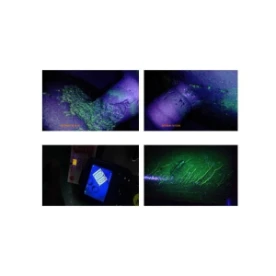
Compared with conventional visible-light industrial borescopes, UV borescopes have exclusive professional imaging performance. Ultraviolet rays can stimulate specific substances to generate fluorescence or obvious reflection luminescence, greatly improving the contrast between defects and base material surfaces. The equipment can prominently highlight hidden hazards such as micro cracks, tiny pores, leakage residual traces and uneven coating layers, making up for the inherent deficiency of white-light endoscopes in identifying subtle tiny defects, and significantly lifting the detection accuracy and overall reliability of industrial non-destructive testing.