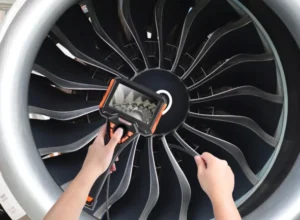

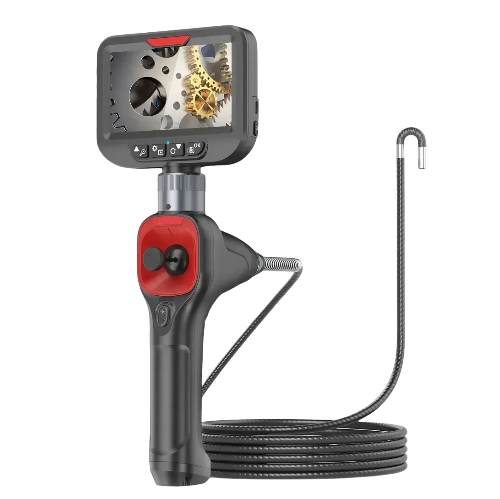
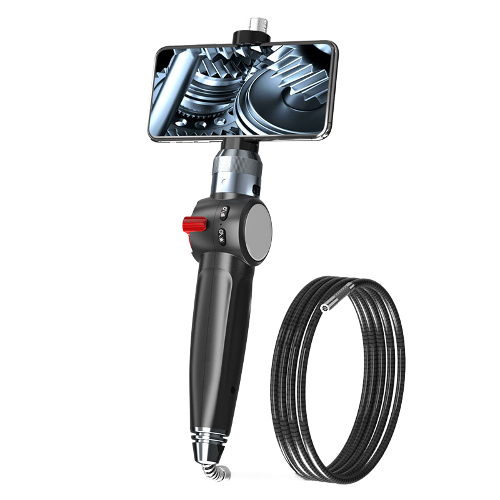
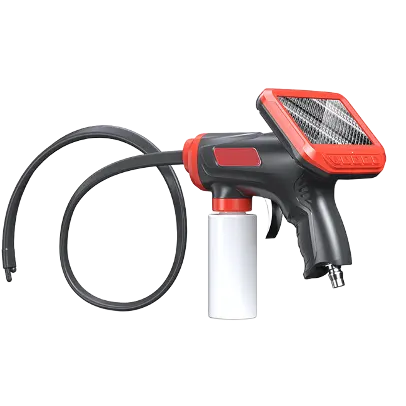
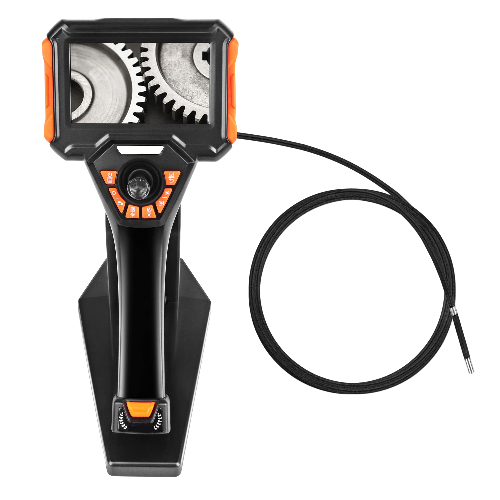
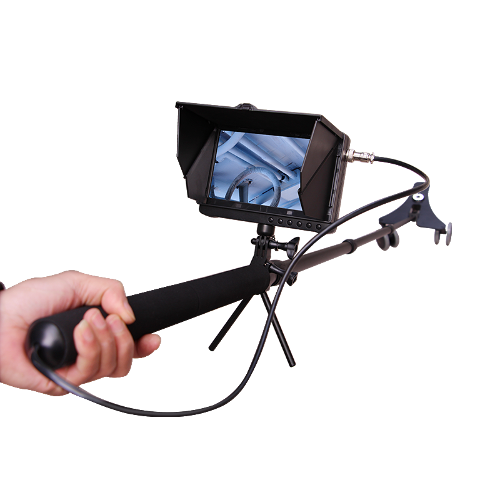
Introduction: Why Does Infrared Borescope Inspection Need Its Own Guide?
In industrial non‑destructive testing (NDT), white‑light video borescopes have long been the tool of choice. Their imaging is intuitive, their colour reproduction accurate, and they handle the vast majority of routine inspection tasks with ease. But when the target is buried inside a pitch‑black enclosed cavity, obscured by smoke or oil contamination, or when the operation demands absolute concealment, white‑light solutions run into hard limits.
The infrared industrial borescope was designed specifically to close that gap. It uses near‑infrared (NIR) illumination invisible to the naked eye, paired with an image sensor tuned to the infrared spectrum, to produce sharp greyscale imagery inside lightless cavities. Its longer wavelength cuts through dust and smoke where visible light scatters and fails. And its inherent zero‑glow characteristic makes it an indispensable tool for covert inspection in law enforcement and security operations.
This guide draws on five specialist technical articles to deliver a structured reference covering product definition, core value, typical applications, selection criteria, and the technology trends shaping the next generation of infrared borescopes. It is written for industrial inspection engineers, procurement decision‑makers, and law enforcement professionals alike.
What Is an Infrared Industrial Borescope?
Definition
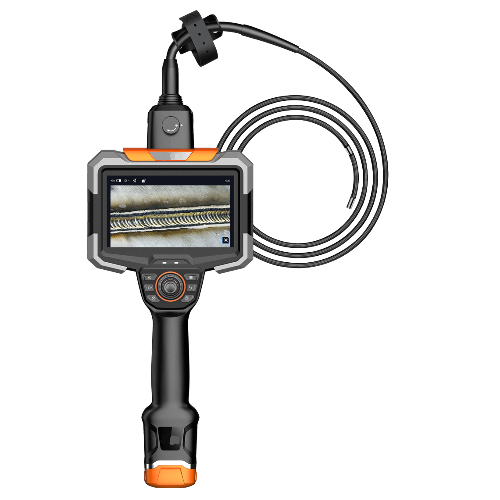
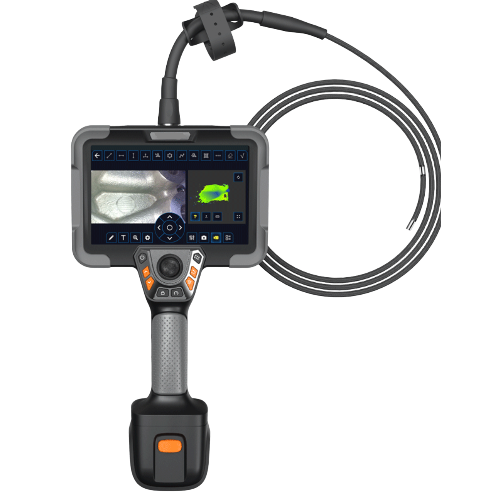
An infrared industrial borescope is a specialised NDT instrument that uses active infrared LED illumination at either 850 nm or 940 nm wavelength. The operating principle is straightforward: the built‑in infrared LEDs project invisible infrared light onto the target surface; an infrared‑sensitive image sensor captures the reflected signal; and a signal processor converts that data into a high‑resolution greyscale image displayed on screen. No visible light escapes the probe during operation, and the system generates no thermal radiation, keeping the inspection process fully concealed and operationally safe.
It is worth noting that infrared industrial borescopes are not a separate product category. They represent an extension of the standard industrial video borescope, with infrared added as a selectable illumination mode. Most mature commercial solutions integrate both white‑light and infrared LEDs in a single probe head, allowing the operator to switch between modes at the press of a button.
Key Components
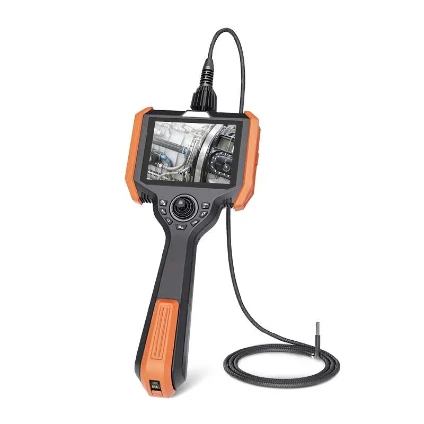
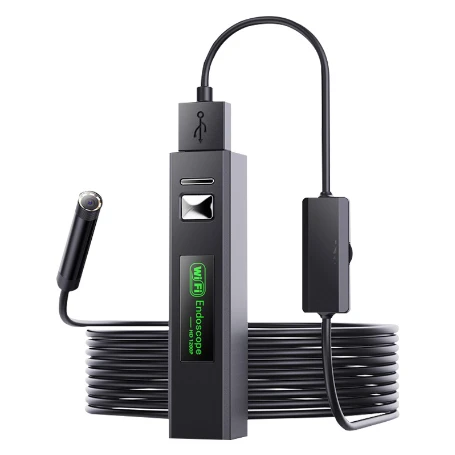
A complete infrared industrial borescope consists of four core modules:
- Probe: The sensing core of the system. It integrates the objective lens, infrared‑sensitive image sensor, infrared LED illumination, and signal transmission cable. The probe is inserted directly into the inspection cavity to capture real‑time imagery.
- Infrared imager: Converts the analogue optical signals returned by the probe into digital image data. This module has a direct bearing on overall image quality.
- Signal processor: Applies noise reduction, gain adjustment, and edge enhancement algorithms to produce a clean, usable inspection image from the raw digital signal.
- Display and main unit: Handles real‑time image display and data storage. Many models also support Wi‑Fi streaming to external devices or command terminals.
Infrared Borescope vs Thermal Imaging Borescope: What Is the Difference?
This is one of the most common points of confusion in the market and warrants a clear distinction.
| Criterion | Infrared Borescope | Thermal Imaging Borescope |
|---|---|---|
| Imaging principle | Active IR illumination; captures reflected light | Passive; detects thermal radiation emitted by the object |
| What it shows | Physical structure: shape, texture, spatial layout | Temperature distribution (thermal map) |
| Image quality | High‑resolution greyscale; near‑photographic clarity | Low structural detail; temperature gradients only |
| Typical use cases | Dark‑environment inspection, covert surveillance, surface defect detection | Equipment thermal anomaly detection, personnel heat signature identification |
| Covert capability | Excellent (940 nm: zero visible glow) | No active illumination required; equally covert |
Wavelength Selection: 850 nm vs 940 nm
Infrared LED illumination is not a single specification. The two wavelengths most commonly encountered in industrial and law enforcement applications are 850 nm and 940 nm, each with distinct trade‑offs between imaging brightness and operational concealment.
| Wavelength | Visible Glow | Concealment Level | Recommended Applications |
|---|---|---|---|
| 850 nm | Faint red glow visible at close range | Moderate | Industrial inspection; concealment not critical |
| 940 nm | Completely invisible to the human eye | Excellent | Law enforcement surveillance, counter‑terrorism, covert night operations |
In short: 850 nm is entirely adequate for industrial inspection tasks. Wherever the operation involves law enforcement, security screening, or any scenario where zero visible light exposure is a hard requirement, specify 940 nm.
Four Core Capabilities of the Infrared Industrial Borescope
High‑Definition Imaging in Complete Darkness
A conventional white‑light borescope relies on its LED array for illumination. Once inserted into a sealed dark cavity, visible light struggles to achieve uniform coverage; shadow zones are inevitable, and image quality suffers accordingly. The infrared borescope operates on an entirely different logic. Rather than depending on ambient or self‑generated visible light, it projects active infrared illumination that fills the space independently of any external conditions. Inside boiler fireboxes, buried pipelines, or large storage vessels where no light penetrates, the infrared borescope consistently delivers clear, stable real‑time imagery.
Beyond its total‑darkness capability, infrared light’s longer wavelength gives it substantially better penetration through dust and smoke than visible light can achieve. In foundries, power equipment enclosures, and similar environments where particulate or smoke density renders white‑light imaging unreliable, infrared imaging holds its clarity. Similarly, on mechanical components coated in oil or grease, visible‑light illumination produces strong specular reflections that obscure critical surface features. Infrared illumination suppresses that glare effectively, restoring an accurate representation of the surface texture and structural profile beneath.
Hazardous‑area applications also benefit. In coal mines, offshore platforms, and other environments classified for the presence of flammable or explosive atmospheres, the relatively low energy output of infrared illumination presents a lower ignition risk than high‑intensity white‑light LEDs.
Zero‑Glow Operational Concealment
This characteristic sets the infrared borescope apart in law enforcement, military, and security applications. A conventional borescope operating in darkness produces a visible red glow from its LEDs — a tell‑tale sign that can compromise the position of the operator. The 940 nm wavelength sits well beyond the human‑visible spectrum (approximately 380–780 nm). Even at close range, it produces no visible hotspot or halo, leaving the target entirely unaware.
In practice, this means an operator can feed a slender flexible probe through door gaps, ventilation slots, cable conduits, or any available narrow opening, and gather real‑time interior imagery throughout without emitting any audible or visible signal. Combined with onboard photo and video capture, the recorded footage constitutes admissible first‑hand evidential material for subsequent legal proceedings.
Dual‑Mode Inspection: Infrared and White Light in a Single Device
This is the defining competitive advantage of the leading products currently on the market. Integrating both white‑light LEDs and infrared illumination in the same probe head — with one‑touch mode switching — eliminates the operational friction of swapping between separate instruments, re‑entering the inspection zone, and recalibrating the viewing angle each time conditions change.
- White‑light mode: Restores true colour and surface texture, enabling precise identification of visible defects including cracks, corrosion, scratches, blockages, and deformation. This mode is the right choice for standard quality inspection under adequate lighting conditions.
- Infrared mode: Purpose‑built for low‑light, lightless, or highly reflective environments where white‑light imaging is insufficient. It fills the detection blind spots that conventional borescopes simply cannot address.
The two modes complement one another. A single integrated unit covers the full spectrum of inspection scenarios from routine preventive maintenance to demanding special‑environment applications, delivering a substantially better return on investment than two separate devices.
Reducing Maintenance Costs and Downtime
Conventional fault diagnosis frequently requires partial or full equipment disassembly followed by extended downtime while components are inspected and reassembled. An infrared borescope probe reaches the inspection zone non‑destructively, locating the fault and assessing defect severity without any disassembly. This directly reduces machine downtime and eliminates the labour costs of unnecessary dismantling, preventing the over‑maintenance cycles — blanket part replacement and full‑section removal — that characterise less informed inspection practices.
More significantly, scheduled borescope inspections allow minor defects to be identified and addressed before they develop into major failures. The cost of a planned, targeted repair is a fraction of an emergency overhaul or equipment write‑off. This preventive inspection philosophy is central to the operating model of any modern smart factory.
Application Scenarios: A Full Overview
Industrial NDT Applications
- Power Generation: Foreign object intrusion, loose connections, and wear inside generators, transformers, GIS switchgear, and circuit breaker assemblies can all be assessed without equipment disassembly. High‑definition imaging is achieved inside dark cavities while the asset remains energised, eliminating unnecessary outages and removing the need for personnel to enter confined spaces.
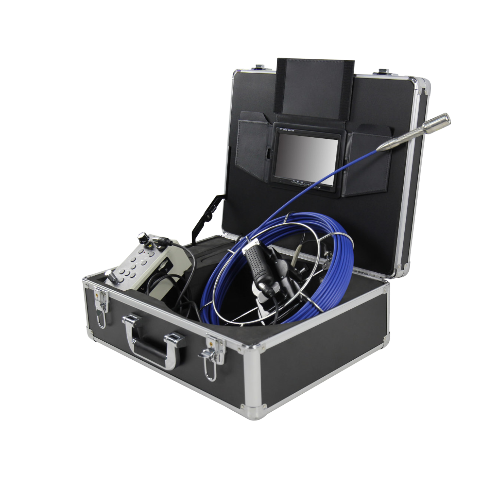
- Oil and Gas / Petrochemical: Internal coking, corrosion, and foreign matter accumulation in pipelines, storage tanks, reactor vessels, and furnace tubes can be captured in a single insertion pass inside dark furnace bodies and tank interiors. This eliminates repeated re‑entry due to inadequate lighting and reduces the economic impact of unplanned shutdowns.
- Aerospace: Turbine blade integrity, combustion chamber inner‑wall condition, and cooling channel blockages demand the highest imaging standards. Infrared mode captures high‑definition detail imagery in lightless environments, confirming that critical components meet airworthiness requirements and preventing catastrophic in‑flight failures.
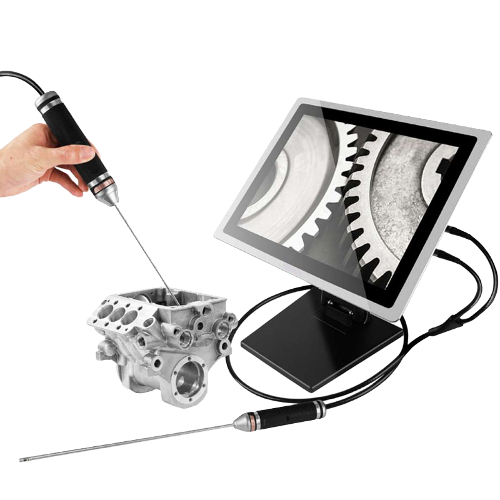
- Automotive Manufacturing: Assembly accuracy and wear condition inside engine blocks, gearboxes, and exhaust systems — all dark, confined spaces — can be inspected without disassembly, shortening product development cycles and reducing unplanned production‑line stoppages.
- General Machinery: Internal condition assessment of hydraulic systems, gearboxes, and bearing housings in dark, oil‑contaminated environments. The infrared borescope reliably identifies metal swarf, scoring, and looseness that represent early‑stage failure indicators.
- Building Services and HVAC: Construction quality and damage assessment inside concealed wall pipework, ductwork, and insulation layers. The system accurately locates water ingress points, blockages, and structural defects in dark voids, providing photographic evidence for construction sign‑off and maintenance records.
Law Enforcement and Public Security Applications
- Covert Night Surveillance: 940 nm illumination is completely invisible under operational conditions. Surveillance operators can work within centimetres of the target, observing interior activity through door gaps or ventilation openings without the subject’s knowledge. Live footage streams directly to a command terminal for real‑time tactical assessment.
- Pre‑Assault Counter‑Terrorism Reconnaissance: Before a tactical entry or hostage rescue operation, teams must establish occupant count, positions, and weapons status inside the target structure. The probe is inserted through natural gaps in the building envelope; live interior imagery is gathered silently, without any audible or visible signal, supporting command decisions while protecting hostages.
- Explosive Ordnance Disposal (EOD): Certain IED designs incorporate light‑sensitive or vibration‑activated trigger mechanisms that respond to intense illumination. The infrared borescope uses cold illumination that generates no thermal radiation, allowing EOD personnel to inspect suspicious packages or sealed compartments from a safe distance without physical contact or opening. The slender probe also reaches irregular cavities that X‑ray systems cannot resolve adequately.
- Suspicious Vehicle Inspection: The probe is inserted through door‑seal gaps, ventilation grilles, or other narrow openings, giving officers a complete view of the vehicle interior and any concealed compartments — without opening doors, touching the vehicle, or triggering any hidden device.
- Border Security and Cargo Inspection: X‑ray scanning of large freight containers or modified luggage compartments does not always provide sufficient detail resolution. An infrared borescope probe inserted between cargo provides real‑time interior imagery at night or in poorly lit port and warehouse environments, complementing X‑ray with the structural detail it cannot supply.
- Criminal Investigation and Forensic Scene Examination: Preserving the integrity of physical evidence requires that investigators document concealed areas without disturbing or moving items. The infrared borescope performs non‑contact imaging inside furniture cavities, wall voids, and pipework that conventional examination techniques cannot reach. Recorded footage is archived directly as formal evidential material.
- Prison and Detention Facility Searches: Beds, toilet cisterns, and ventilation ducts are well‑established concealment locations. Systematic probe inspection of these cavities significantly improves search efficiency while reducing the direct contact between custody staff and potentially hazardous concealed items.
How to Specify and Purchase an Infrared Industrial Borescope
Step One: Establish Whether Infrared Mode Is Actually Required
Not every inspection task benefits from infrared capability. Where the working environment is adequately lit and covert operation is not a requirement, a standard white‑light borescope covers the vast majority of routine structural inspection needs. There is no value in paying for infrared functionality that will not be used.
Infrared mode becomes necessary in the following situations:
- The inspection environment is completely dark (sealed cavities, night‑time operations)
- Dust or smoke is present and degrades visible‑light image quality
- The inspection surface is highly reflective (polished metal, plastic components) and specular glare must be suppressed
- The operation is in a law enforcement or security context and zero visible light exposure is required
Step Two: Confirm the Key Technical Parameters
Once the need for infrared is established, the following parameters determine whether a given model is fit for the intended application:
- Probe diameter and articulation angle: Select the largest diameter that fits the access opening. A minimum articulation range of 180° is strongly recommended to eliminate inspection dead zones inside the cavity.
- Insertion tube length: Match this to the actual depth of the deepest cavity or pipeline to be inspected. Avoid both over‑specifying (which adds unnecessary weight and stiffness) and under‑specifying (which limits reach).
- Ingress protection rating: IP67 is the industry baseline for industrial applications. Harsh environments may warrant a higher rating.
- Illumination system: An integrated dual‑light design with one‑touch switching between white light and infrared is strongly recommended over a dedicated infrared‑only unit. A single device covering both modes delivers substantially greater operational value.
- Infrared wavelength: 940 nm for law enforcement and security operations; 850 nm is adequate for standard industrial inspection.
Step Three: Select Optional Features to Suit the Application
With the core parameters confirmed, the following functional modules can be specified as needed:
- Photo and video capture: Essential for any application involving documentation, evidence collection, or quality assurance record‑keeping.
- Wi‑Fi real‑time streaming and multi‑screen simultaneous display: Suited to scenarios requiring collaborative observation or remote command support, such as security pre‑event checks and counter‑terrorism reconnaissance.
- Wireless and portable design: Relevant where the inspection is conducted in the field or in complex access environments.
Procurement Summary
There is no need to treat the infrared borescope as an entirely separate procurement category. The correct approach is to specify a multi‑function unit with an integrated dual‑light‑source design — one device that covers both white‑light and infrared modes within a reasonable budget. This is the mainstream commercial solution for good reason: it maximises application coverage while minimising capital expenditure.
Four Technology Trends Shaping the Next Generation
Iterative Improvement in Infrared High‑Definition Imaging
The central tension driving this trend is a widening gap between the rising inspection standards of precision manufacturing and the imaging limitations that persist in conventional infrared borescopes — specifically, excessive noise in low‑light conditions, inadequate fine‑detail reproduction, and poor exposure balance between close‑range and distant subjects.
The roadmap to address this includes next‑generation dedicated infrared CMOS image sensor chips, optimised anti‑reflection coatings on infrared optical lenses, and updated low‑light gain processing algorithms — all targeting a step‑change improvement in imaging clarity under low‑light enclosed conditions. The progressive adoption of optical zoom and lossless digital image magnification will raise the attainable inspection resolution by an order of magnitude, bringing infrared borescopes into alignment with the stringent tolerances demanded by high‑end precision manufacturing.
Integrated Dual‑Light‑Source Design as the Market Standard
In the traditional approach, white‑light borescopes and infrared inspection cameras were two separate instruments. On‑site operation required frequent equipment changes, reducing efficiency and making it impossible to compare images captured under the two illumination modes from the same probe position and angle.
The dominant trend today is to integrate both white‑light LEDs and infrared emitters into a single probe head with one‑touch switching. This not only reduces operational complexity but directly solves the positional misalignment problem inherent in switching between separate devices — delivering the full complementary value of dual‑mode inspection in a single instrument.
Deep Integration with Artificial Intelligence
The inspection accuracy and throughput of conventional borescope systems are directly limited by the skill and attention of the operator. Manual misjudgement, missed detections, and the inability to produce traceable inspection records are long‑standing weaknesses that the industry has not been able to solve through hardware alone.
AI integration addresses this at the root. An intelligent infrared borescope equipped with built‑in defect‑recognition algorithms can automatically identify anomalies — cracks, deformation, blockages, wear — within the inspection image, mark defect locations, compile defect statistics, and generate a standardised inspection report, all without secondary manual review. The practical significance of this shift is a fundamental upgrade from a device that sees to one that understands and diagnoses.
Miniaturisation and Modularisation in Parallel
Ultra‑fine pipelines, precision instrument interiors, and multi‑layer sealed structures impose probe size and flexibility requirements that current infrared borescopes cannot always meet. Conventional probes remain comparatively large in diameter and restricted in bending range, limiting their reach in the most demanding access conditions.
Two parallel development paths are emerging to address this. The first is extreme probe miniaturisation: substantially reducing probe diameter while preserving full HD infrared imaging performance, and improving articulation to support wide‑angle free steering in all directions. The second is modular device architecture: lens, probe, insertion tube, and main unit designed for tool‑free field replacement, enabling adaptation to different inspection conditions without returning equipment to a service centre. Lightweight body designs and wireless transmission will simultaneously eliminate the bulk, cable management complexity, and restricted mobility that have long been associated with traditional inspection equipment.
Conclusion
The infrared industrial borescope is not a replacement for the white‑light borescope. It is a professional extension of it, purpose‑built for the working conditions where visible‑light inspection fails: complete darkness, smoke‑ and dust‑laden environments, highly reflective surfaces, and operations demanding zero visible light exposure. Its four core capabilities — total‑darkness imaging, infrared‑light penetration, zero‑glow concealment, and dual‑mode complementary diagnostics — address the precise inspection gaps that conventional tools cannot fill.
For procurement decision‑makers, the central recommendation is this: specify an integrated dual‑light‑source unit rather than a dedicated infrared‑only device. A single instrument covering both illumination modes delivers the maximum application coverage for the minimum capital outlay. Then, based on whether the application involves law enforcement, covert security work, or standard industrial inspection, select between 940 nm and 850 nm accordingly.
As AI algorithms, probe miniaturisation, and modular design continue to advance, the inspection accuracy and application reach of infrared borescopes are expanding rapidly. These instruments are positioned to play an increasingly indispensable role across industrial precision manufacturing, energy asset maintenance, and public safety operations in the years ahead.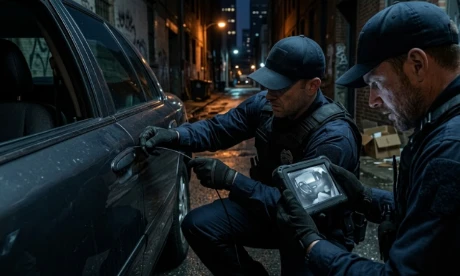
Frequently Asked Questions (FAQ)
- Q1: What is the core difference between an infrared inspection camera and a standard white‑light borescope?
- The fundamental difference is the light source and the working conditions each is designed for. White‑light borescopes use visible LED illumination with accurate colour reproduction, making them ideal for surface appearance inspection under normal lighting. Infrared inspection cameras use active near‑infrared illumination invisible to the human eye, maintaining clear greyscale imaging in complete darkness, smoke‑filled, or highly reflective environments. The two are complementary rather than interchangeable. A dual‑light integrated unit that covers both modes in a single device currently represents the best practical value on the market.
- Q2: Can an infrared borescope produce usable images in complete darkness?
- Yes. An active infrared inspection camera carries its own onboard infrared LED illumination and requires no ambient light of any kind. It produces clear imagery inside completely dark enclosed cavities with an effective viewing range of up to 18 metres. This is fundamentally different from passive thermal imaging, which depends on temperature differentials between surfaces. The image quality of an infrared inspection camera is independent of the surface temperature of the inspected object.
- Q3: How do I choose between 850 nm and 940 nm infrared illumination?
- The primary difference is operational concealment. At 850 nm, a faint red glow is visible at close range — a phenomenon sometimes called hot‑spot emission. At 940 nm, the output falls entirely outside the human‑visible spectrum and produces no visible light whatsoever, even when the probe is used at close quarters. For routine industrial inspection, 850 nm is perfectly adequate and typically provides marginally higher image brightness. For law enforcement surveillance, counter‑terrorism operations, security screening, or any scenario where zero visible light exposure is a hard operational requirement, 940 nm models must be specified.
- Q4: What is the difference between an infrared borescope and a thermal imaging borescope, and can they replace each other?
- The two instruments operate on fundamentally different principles and cannot substitute for one another. An infrared borescope actively emits near‑infrared light and images the reflected signal, producing high‑resolution structural imagery that reveals the shape, texture, and spatial relationships of the inspected object with near‑photographic clarity. A thermal imaging borescope passively detects the thermal radiation emitted by objects and displays a temperature‑distribution map. It excels at identifying heat anomalies in equipment or human heat signatures, but cannot resolve the structural and surface detail that an infrared borescope captures. Selection should be governed by whether the inspection objective is structural assessment or thermal anomaly detection.
- Q5: Is it necessary to purchase a dedicated infrared‑only borescope separately?
- Generally, no. The correct specification approach is to verify that the chosen device includes an infrared observation mode as standard, rather than procuring a separate infrared‑only instrument. The mainstream commercial offering is a dual‑light unit with one‑touch switching between infrared and white‑light modes. This single device covers both routine white‑light inspection and specialised infrared detection, delivering far better value for money than maintaining two separate instruments and eliminating the operational overhead of equipment changeovers on site.
- Q6: What are the most important technology trends to monitor in infrared borescope development?
- Four trends are currently reshaping the product landscape: continuous improvement in infrared imaging resolution, driven by next‑generation CMOS sensors and low‑light processing algorithms; the standardisation of integrated dual‑light designs across the commercial product range; AI‑powered automatic defect recognition and standardised report generation; and parallel advances in extreme probe miniaturisation and modular device architecture. Taken together, these developments represent a progression from instruments that simply capture images to systems that actively interpret what they see and generate actionable inspection intelligence.
- Q7: What is the minimum gap width that a law enforcement infrared borescope probe can pass through?
- Professional‑grade law enforcement models are available with probe diameters as small as 3.9 mm. With flexible articulation, they can typically be inserted through openings of approximately 5 mm or wider, covering most door gaps, ventilation grilles, and wall apertures encountered in operational environments. Actual insertability also depends on the depth and internal geometry of the gap, the required bending radius, and the presence of internal obstacles. Confirm the probe flexibility specification and minimum bending radius with the supplier when evaluating equipment for a specific operational requirement.