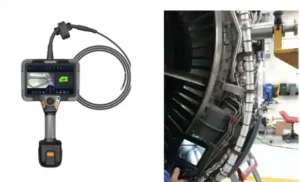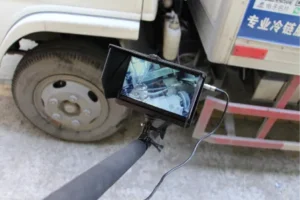

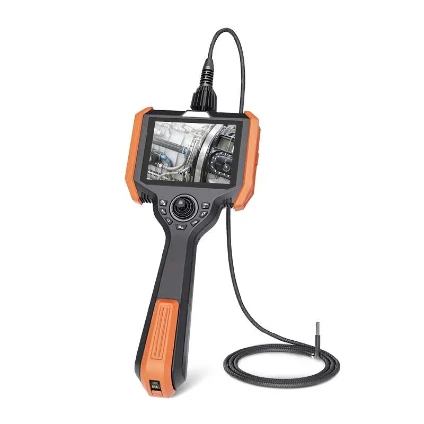
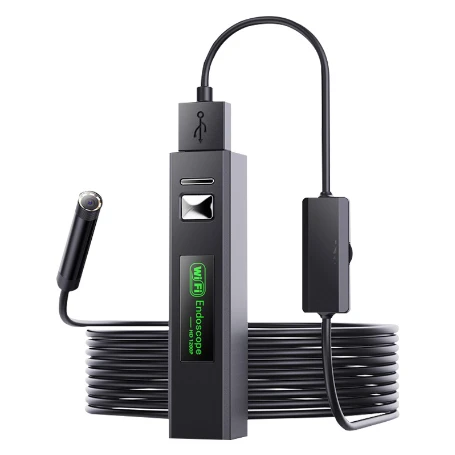
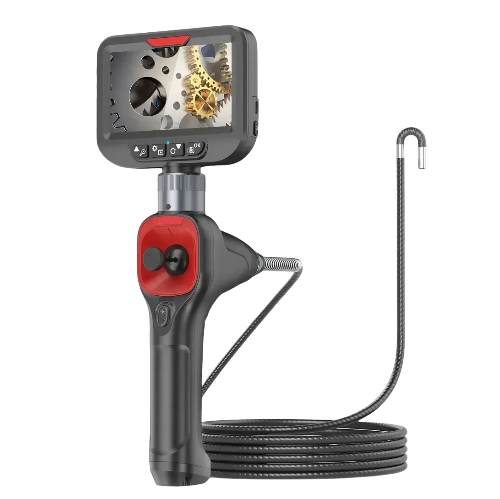
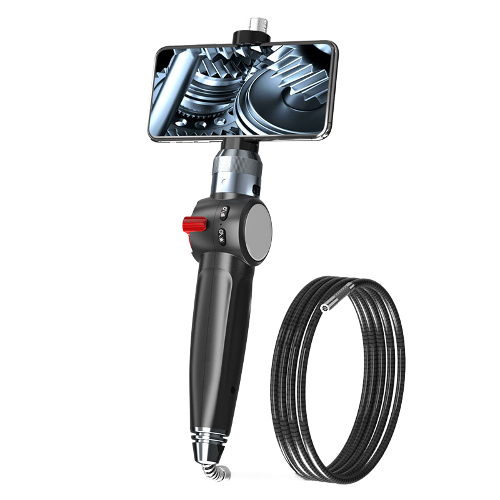
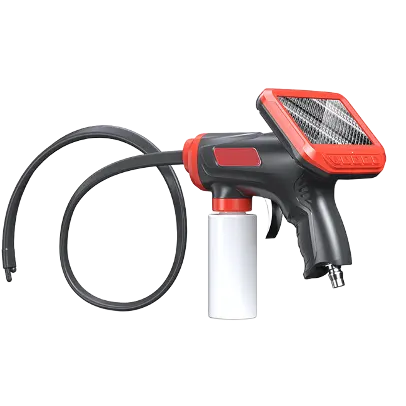
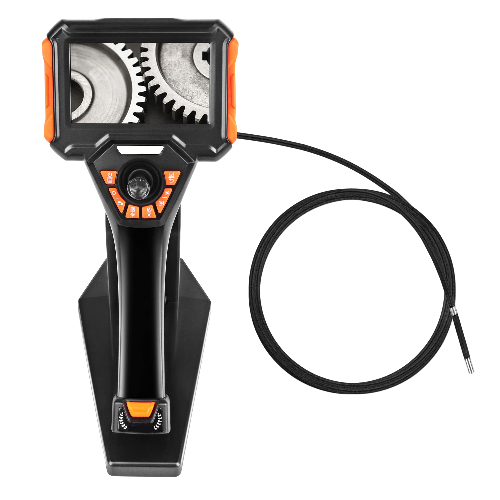
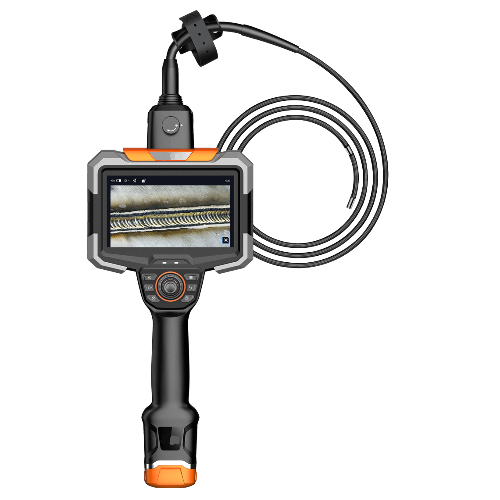
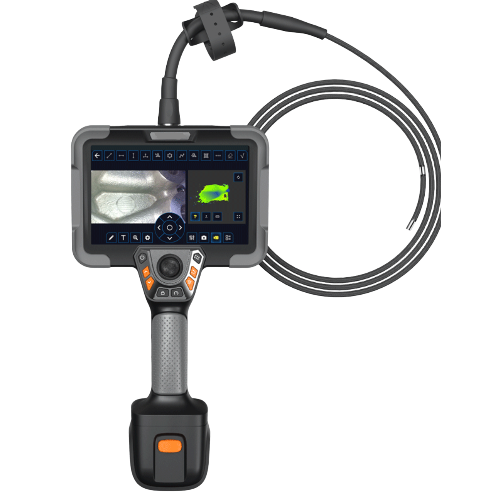
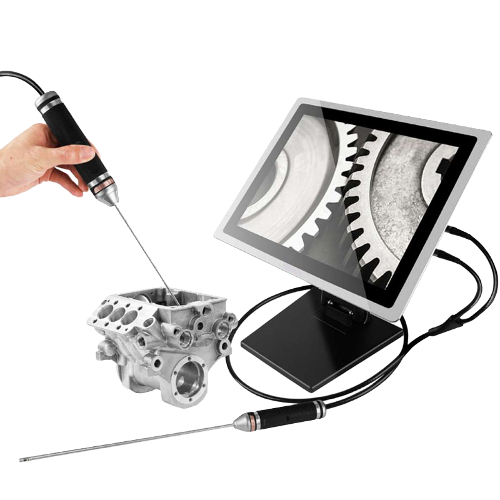
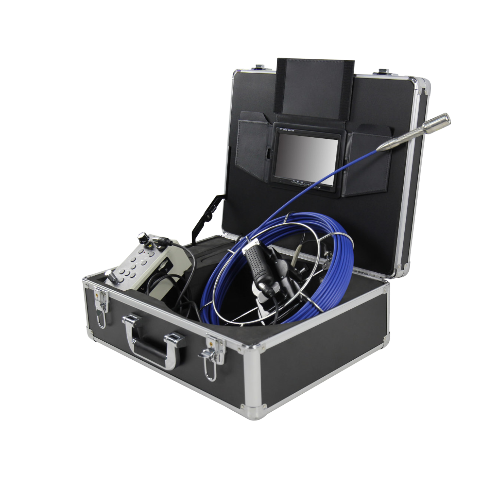
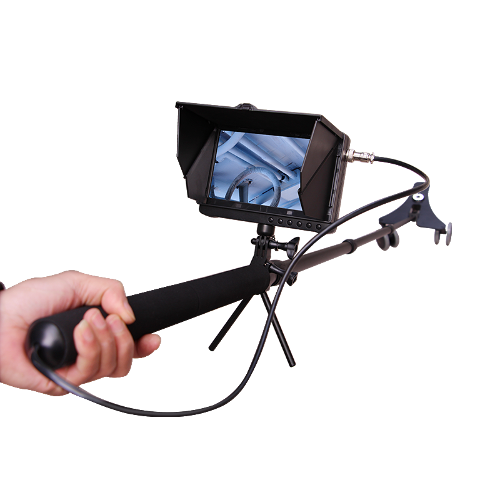
What are the future evolution directions of ultra-thin borescopes? From continuous breakthroughs in probe outer diameter, iterative upgrades of imaging definition, to deep fusion of artificial intelligence and miniaturized optical systems, industrial ultra-thin borescopes are evolving toward smaller size, clearer imaging and higher intelligence. In the future, they will no longer serve merely as simple visual observation tools, but evolve into intelligent inspection platforms capable of automatic defect identification and independent path planning, emerging as core guarantee equipment for product quality and operational safety in aerospace, new energy vehicles, semiconductors and other precision manufacturing sectors.
Sustained Breakthroughs in Probe Outer Diameter
In the past five years, the mainstream outer diameter of ultra-thin borescopes has shrunk from 2.5–3.0 mm down to 1.5–2.0 mm. Since 2024, products with diameters below 1.0 mm have become the key technical competition focus for leading manufacturers and emerging enterprises.
The iteration gradient of current industrial ultra-thin borescope diameters is clearly layered:
- 1.0 mm–2.0 mm: Mature mass production realized, widely adopted for conventional precision machinery inspection;
- 0.5 mm–1.0 mm: Commercially available from top manufacturers, extensively deployed for micro-cavity inspection and high-end equipment maintenance;
- 0.3 mm–0.5 mm: Still undergoing technical verification, mainly applied to microelectronic packaging internal inspection and MEMS device failure analysis.
In the next 3 to 5 years, the probe diameter of industrial ultra-thin borescopes will break the 0.5 mm threshold. Meanwhile, motion control precision and imaging performance will be synchronously optimized to accommodate inspection requirements for more ultra-fine precision components.
Comprehensive Upgrading of Imaging Technology
While breaking through dimensional limits, ultra-thin borescopes are realizing qualitative leap in imaging performance, shifting from simply recognizing workpiece contours to accurately pinpointing subtle defects. Three major imaging technology upgrades will be carried out to resolve common pain points including slim probe with blurry images and poor environmental adaptability, forming core product competitive differentiation.
Higher Definition Imaging
Full-scale popularization of HD and UHD imaging technology, coupled with domestic breakthroughs in miniature CMOS sensors, delivers substantial improvement in imaging sharpness. Tiny defects such as microcracks, surface wear and carbon deposition on precision parts can be displayed distinctly, boosting inspection accuracy for semiconductor chip packaging, aero-engine components and other high-precision scenarios.
Miniaturized Panoramic Imaging
Conventional borescopes rely on probe rotation to complete 360° observation, which is severely restricted inside narrow cavities. In the future, miniature conical mirrors or fisheye optical structures will be embedded into ultra-thin probes to acquire full 360° unfolded images with a single insertion. This technology fits turbine blade cooling hole inspection and full internal scanning of precision castings perfectly.
Industrialized Application of Multispectral Imaging
Different material defects present unique reflectance characteristics under specific wavelengths, making multispectral imaging (ultraviolet, blue light, infrared) a standard extended function for ultra-thin industrial borescopes:
- Ultraviolet band: Efficiently identifies oil stains and adhesive residues;
- Blue light band: Generates high contrast for metal surface microcrack detection;
- Infrared band: Detects thermal damage and subsurface material defects.
The multispectral light source system can be integrated into a 1.0 mm diameter probe without increasing overall outer dimension, expanding inspection dimensions greatly.
Deep AI Integration to Reconstruct Inspection Workflow
Large-scale AI deployment thoroughly changes the application mode of ultra-thin borescopes, transforming them from pure visual viewing equipment into integrated inspection terminals supporting intelligent identification, quantitative analysis and autonomous operation. It drastically lifts inspection efficiency and lowers reliance on experienced operators, becoming the most important long-term development direction.
Automatic Defect Identification & Quantitative Calculation
AI algorithms trained with massive industrial defect datasets can rapidly classify cracks, ablation, pits, carbon deposition and other flaw types, and automatically calculate defect length, depth, area and other dimensional indicators without manual measurement. Inspection efficiency is raised by over 50% while effectively eliminating human subjective errors.
Combined with magnetic drive technology, the probe can navigate independently inside complex pipelines and component cavities, actively avoiding obstacles and finishing full-coverage inspection with no manual intervention, suitable for hard-to-operate working conditions such as aero-engine interiors and intricate bent pipelines.
Cloud Data Interconnection
Linked with industrial IoT, inspection data is uploaded to the cloud platform in real time for unified storage, intelligent analysis and early warning push, supporting full-cycle predictive maintenance and cutting equipment downtime and inspection labor costs.
Scenario Expansion & Diversified In-depth Layout Focusing on High-End Manufacturing
Driven by booming new energy vehicles, semiconductors, aerospace and high-end equipment industries, the demand for ultra-precision inspection keeps rising steadily. Application boundaries of ultra-thin borescopes extend from general conventional detection to segmented high-end manufacturing fields, forming diversified growth momentum.
Aerospace Industry
It remains the core downstream application market with continuously growing demand, used for detecting turbine blade cooling holes, fuel nozzle carbon accumulation and fuselage tiny pipeline corrosion and wear. All inspection work is finished without disassembly to guarantee flight safety. Benefiting from domestic large aircraft and commercial aerospace expansion, annual market demand growth will exceed 25%.
New Energy Vehicles
Mainly deployed to inspect battery pole tabs, motor stators and small oil circuits, accurately capturing tab welding defects and pipeline blockages to improve power battery safety and drive system reliability. It has become a brand-new high-growth market for the industry.
Semiconductor Industry
As chip processes shrink to 7 nm and below, higher precision standards are raised for packaging and wafer production. Ultra-thin borescopes detect packaging internal solder joint defects and additive manufacturing residual powder, realizing micron-level (5 μm) flaw identification to match high-end chip manufacturing requirements; the market scale is expected to double within three years.
Power Equipment Industry
Applied to inspect scaling and corrosion inside gas turbine blade cooling holes and tiny heat exchange pipelines, facilitating predictive maintenance and reducing economic losses caused by unplanned shutdown.
Other Emerging Application Fields
Application penetration keeps rising in petrochemical, high-end equipment manufacturing and other traditional industries, covering more ultra-fine precision inspection scenarios. Meanwhile, fueled by AR/VR industrial upgrading, miniature borescope optical modules see surging demand; optimized optical waveguide and diffractive optical technologies cut module volume by 70% and cost by 50%. The product line expands from industrial NDT to consumer electronics, opening up new market space.
Summary & Outlook
In the coming 3–5 years, ultra-thin industrial borescopes will keep breaking through diameter bottlenecks, upgrade imaging performance continuously and accelerate AI intelligent embedding, fully satisfying ultra-precision inspection demands across high-end manufacturing sectors. Driven by strong demand from aerospace, semiconductors and new energy vehicles, technological iteration and scenario expansion will promote mutual advancement. Evolving from traditional simple visual tools to complete intelligent inspection systems, they will strongly support quality improvement, efficiency optimization and stable equipment operation in high-end manufacturing, possessing extremely broad development prospects.